Most plumbing systems don’t fail because of the pipe.
They fail at the joint.
A bathroom wall that stays damp, a slow drop in pressure, or repeated repair work—these problems usually trace back to how the pipes were connected. The material may be strong, but the connection between two pieces decides how long the system actually lasts.
In Indian homes, this becomes even more critical. Heat, pressure fluctuations, and water quality put continuous stress on joints. A small mistake during installation can stay hidden for months and then turn into a major issue.
This is where CPVC solvent cement becomes important. It is not just used to join pipes. It determines whether the plumbing system performs reliably over years or starts failing early.
TL;DR
- CPVC solvent cement fuses pipes, not just sticks them
- Proper application decides joint strength
- 1-step cement works for most homes
- Temperature and humidity affect curing
- Installation mistakes cause most failures
- Use compatible systems for best results
Table of Contents
- What is CPVC Solvent Cement and Why It Matters
- How Solvent Welding Actually Works
- CPVC Solvent Cement Uses in Real Plumbing Systems
- 1-Step vs 2-Step Cement: What Should You Choose
- Step-by-Step Installation: Getting the Joint Right
- Indian Conditions That Affect Plumbing Performance
- Common Installation Mistakes and Their Impact
- CPVC vs Other Pipe Systems: What Changes in Practice
- How to Ensure Long-Term Plumbing Reliability
- FAQs
What is CPVC Solvent Cement and Why It Matters
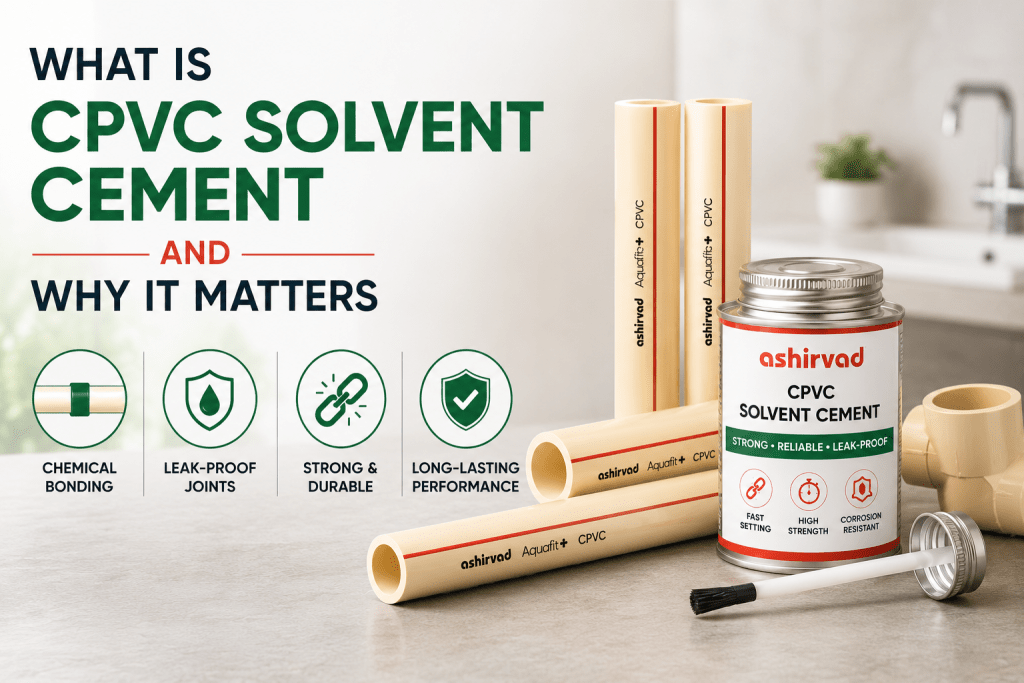
Many people assume CPVC solvent cement works like glue. It does not.
It creates a chemical fusion between the pipe and fitting, turning them into a single continuous structure. This process eliminates weak bonding layers and ensures the joint performs as part of the pipe itself.
Why this matters in real usage
- No separate bonding layer: The absence of an external adhesive layer reduces the chances of joint separation under pressure.
- Uniform strength across the joint: The fused area becomes as strong as the pipe, ensuring consistent performance over time.
- Higher resistance to pressure and heat: Properly fused joints can withstand Indian plumbing conditions without weakening.
In practical terms, a correctly made joint often outperforms the pipe itself in durability.
How Solvent Welding Actually Works
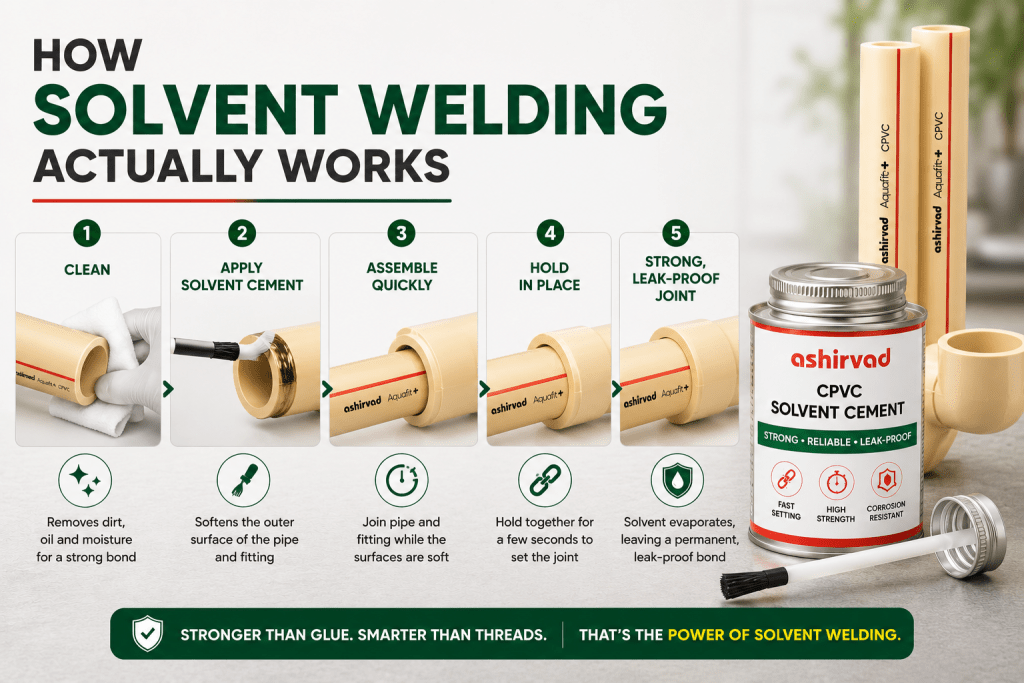
CPVC solvent cement works at a molecular level rather than a surface level.
When applied, the solvent softens the outer layer of both the pipe and the fitting. This allows the materials to merge before hardening into a single structure as the solvent evaporates.
What happens during the application
- Surface softening: The solvent temporarily dissolves the outer layer of CPVC to enable bonding.
- Material fusion: The pipe and fitting merge at a molecular level to form a unified structure.
- Evaporation and hardening: As the solvent evaporates, the joint solidifies into a strong, leak-proof connection.
This process explains why technique matters more than just using the right material.
CPVC Solvent Cement Uses in Real Plumbing Systems
Understanding CPVC solvent cement uses helps in applying it correctly across different plumbing scenarios.
It is primarily used to create leak-proof joints in both residential and commercial piping systems, especially where durability and pressure resistance are required.
Where it is commonly used
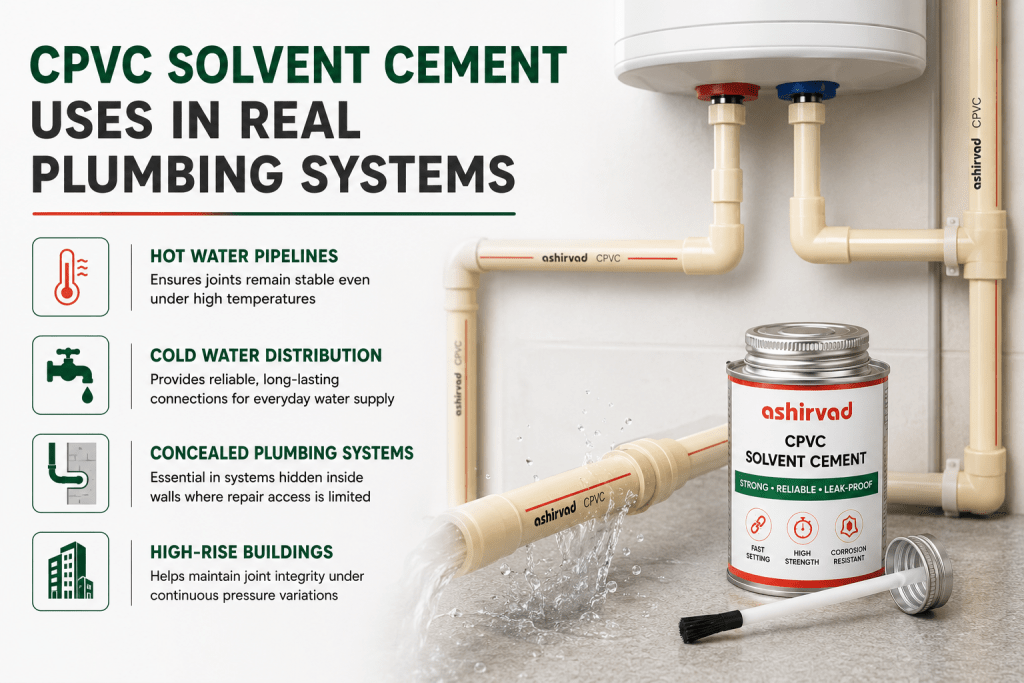
- Hot water pipelines: It ensures joints remain stable even under high temperatures from geysers and solar heaters.
- Cold water distribution systems: It provides reliable, long-lasting connections for everyday water supply.
- Concealed plumbing systems: It is essential in systems hidden inside walls where repair access is limited.
- High-rise buildings: It helps maintain joint integrity under continuous pressure variations.
Proper use of CPVC solvent cement ensures consistent performance across all these applications.
1-Step vs 2-Step Cement: What Should You Choose
Choosing the right type of CPVC solvent cement depends on the scale and application of the plumbing system.
1-Step Cement (Residential use)
- No primer required: Simplifies the installation process and reduces application time.
- Faster jointing process: Makes it suitable for standard residential plumbing tasks.
- Ideal for smaller pipe sizes: Works effectively for pipes typically used in homes.
This makes it the most practical choice for bathrooms, kitchens, and general home plumbing.
2-Step Cement (Commercial and industrial use)
- Requires primer before application: Ensures deeper surface preparation and stronger bonding.
- Creates stronger fusion for large pipes: Suitable for systems that handle higher loads.
- Used in demanding environments: Common in industrial or large-scale commercial projects.
For most Indian homes, 1-step cement is sufficient and easier to apply.
Step-by-Step Installation: Getting the Joint Right
Even high-quality CPVC solvent cement can fail if the application process is incorrect.
Critical installation steps
- Clean and straight cutting: Ensures the pipe fits properly without gaps that weaken the joint.
- Deburring and chamfering: Prevents sharp edges from scraping away cement during insertion.
- Dry fit check: Confirms correct alignment and avoids forced fitting that can damage joints.
- Correct cement application: Ensures proper coverage for strong bonding between surfaces.
- Insertion with slight rotation: Helps distribute the cement evenly across the joint.
- Holding time after insertion: Prevents push-back and ensures initial bonding strength.
Skipping any of these steps increases the likelihood of joint failure.
Indian Conditions That Affect Plumbing Performance
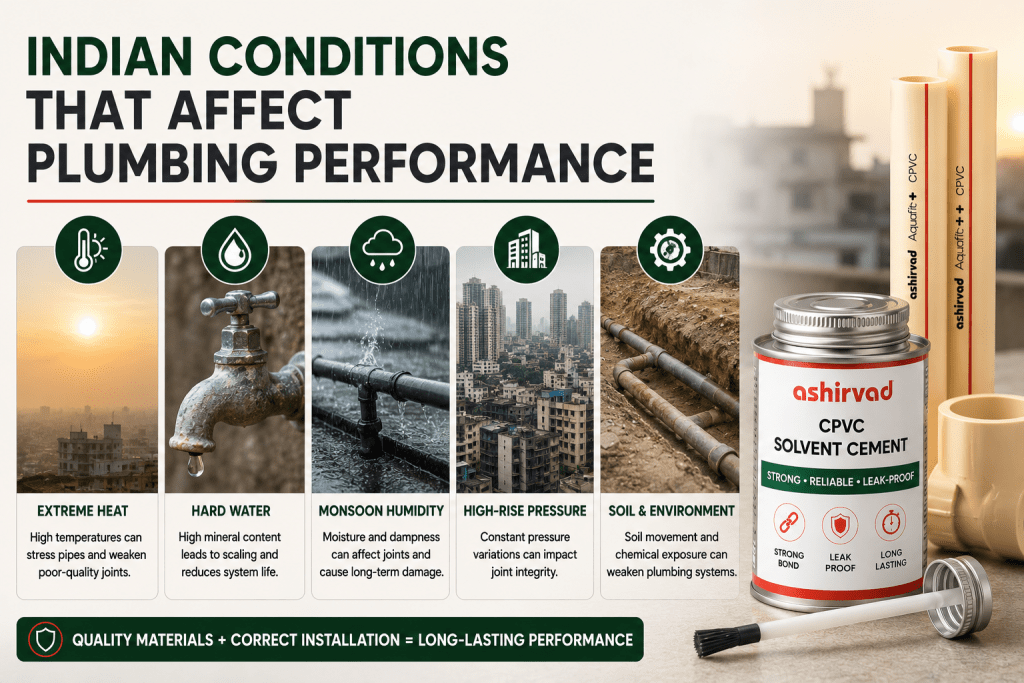
Plumbing systems in India operate under conditions that directly impact how CPVC solvent cement performs.
High temperature environments
- Faster solvent evaporation: Causes cement to dry quickly, increasing the risk of incomplete bonding.
- Need for controlled application: Working in shaded areas helps maintain proper application consistency.
High humidity conditions
- Slower curing process: Moisture in the air delays the hardening of the joint.
- Extended curing time required: Allowing additional time ensures proper joint strength.
Hard water conditions
- No scaling inside CPVC pipes: Smooth internal surfaces maintain consistent flow over time.
- Better long-term performance: CPVC systems remain unaffected by mineral deposits.
Understanding these conditions helps ensure correct application and long-term reliability.
Common Installation Mistakes and Their Impact
Most plumbing failures occur due to avoidable installation errors.
Frequent mistakes
- Dry joints: Occur when cement dries before assembly, resulting in weak bonding and leakage.
- Excess cement application: Leads to internal buildup that weakens the pipe structure.
- Skipping chamfering: Causes uneven application and poor adhesion at the joint.
- Using incorrect cement type: PVC cement does not bond properly with CPVC material.
- Ignoring compatibility issues: Exposure to incompatible materials can lead to long-term cracking.
These mistakes often remain hidden initially but lead to failures over time.
CPVC vs Other Pipe Systems: What Changes in Practice
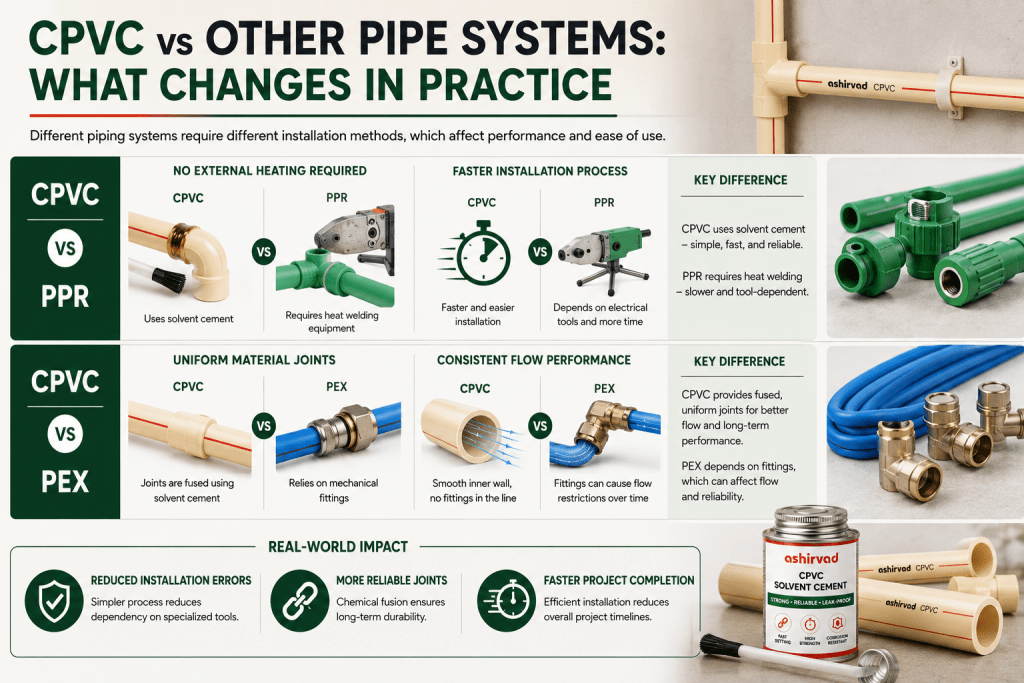
Different piping systems require different installation methods, which affect performance and ease of use.
CPVC vs PPR
- No external heating required: CPVC uses solvent cement, while PPR requires heat welding equipment.
- Faster installation process: Eliminates dependency on electrical tools and reduces installation time.
CPVC vs PEX
- Uniform material joints: CPVC joints are fused, while PEX relies on mechanical fittings.
- Consistent flow performance: Absence of mechanical fittings reduces flow restrictions.
Real-world impact
- Reduced installation errors: Simpler process reduces dependency on specialized tools.
- More reliable joints: Chemical fusion ensures long-term durability.
- Faster project completion: Efficient installation reduces overall project timelines.
How to Ensure Long-Term Plumbing Reliability
Long-term performance depends on both installation quality and system compatibility.
Before closing walls
- Pressure testing with water: Helps identify leaks early before finishing work begins.
- Visual inspection of joints: Ensures uniform application and proper bonding.
- Adequate curing time: Prevents premature failure under pressure.
- Avoiding incompatible materials: Reduces the risk of long-term degradation.
For exposed systems
- Protection from sunlight: Prevents material degradation due to UV exposure.
- Use of water-based paint if required: Maintains pipe integrity without affecting performance.
Consistent systems, such as those used in Ashirvad piping solutions, ensure compatibility across pipes, fittings, and CPVC solvent cement.
Conclusion
A plumbing system does not fail all at once.
It fails at the point where two pipes meet. That moment during installation decides whether the system will last for years or start creating problems early. Getting that step right makes all the difference.
FAQs
What is the best CPVC solvent cement for joining CPVC pipes in home plumbing projects?
The best CPVC solvent cement for home plumbing is one that provides strong chemical fusion, is easy to apply, and works well under Indian temperature conditions. It should be compatible with CPVC pipes and fittings and offer reliable performance for both hot and cold water systems.
How do CPVC solvent cements differ from other pipe cements, and which brand is most reliable?
CPVC solvent cement differs from PVC cement because it is designed to fuse CPVC material at higher temperatures. It creates a stronger bond suitable for hot water systems, while PVC cement is limited to lower temperatures. Reliable brands offer consistent performance and compatibility across systems.
Can I use CPVC solvent cement with CPVC solvent tubes and gums, or are there compatibility issues?
CPVC solvent cement should only be used with compatible CPVC pipes and fittings. Using it with incompatible materials or alternative adhesives can result in weak joints and long-term failure, so it is important to follow manufacturer recommendations.
What are the proper steps and safety precautions when applying CPVC solvent cement?
Proper application includes cleaning the pipe, applying cement evenly, inserting with rotation, and allowing sufficient curing time. Safety precautions include working in ventilated areas, avoiding skin contact, and storing cement away from heat or open flames.v